
HDI boards
Fine lines, thin materials and stacked microvias for dense routing.
HDI capabilities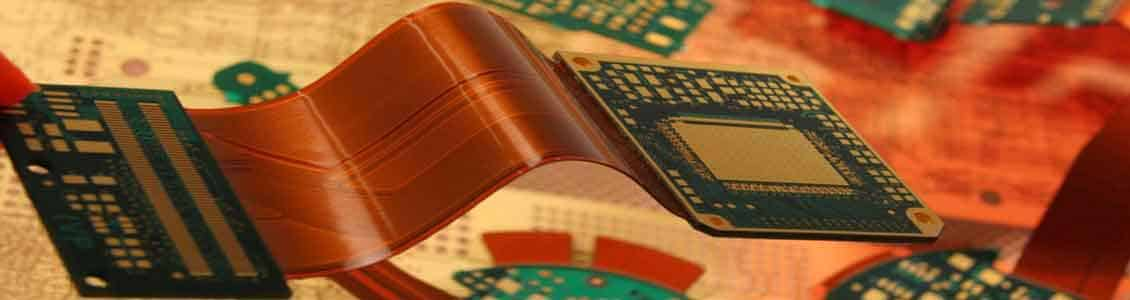
Flex and rigid-flex circuitry is a straightforward way to tie several board assemblies together, along with displays, inputs and storage devices, without wires, cables or connectors between them. Thin, light composites take their place, carrying the wiring in ultra-thin flexible ribbons that run between the sections.
In a rigid-flex build, a flexible substrate forms the backbone of the wiring and rigid multilayer sections are built up on it as modules wherever the design needs them.
Reliability is the other reason people choose it. Mean time between failures is typically better than an equivalent set of standard boards joined by discrete wires and connectors, which is why engineers reach for it when consistent performance matters more than the lower unit cost of separate boards.
Our engineering team works with customers on design for manufacture. We have supported flex-dependent designs from prototype through to end of life, and most of that work comes down to finding yield improvements and cost savings early, while the design can still absorb them. Flex and rigid-flex fabrication runs at our facilities in India, from prototype quantities upwards.
Fine lines, thin materials and stacked microvias for dense routing.
HDI capabilitiesLow-loss laminates and tight registration for gigahertz signals.
RF capabilitiesThe carrier between die and board, by wire bond or flip chip.
Substrate detailsStackup review and DFM feedback come back with the price.